
The customer journey; it’s never a straightforward process.
When it comes to thinking about a customer’s journey, we often think of it as a linear journey, simplifying it to:
- Customer sees product / service
- Customer decides they want to purchase said product / service
- Customer purchase said product / service
- Transaction complete. Job done
However, it never quite works out like that. There are many frameworks you can use to discuss customer journey’s but for this blog we will focus on the McKinsey Consumer Decision Journey. I find that using an example can explain frameworks more clearly.
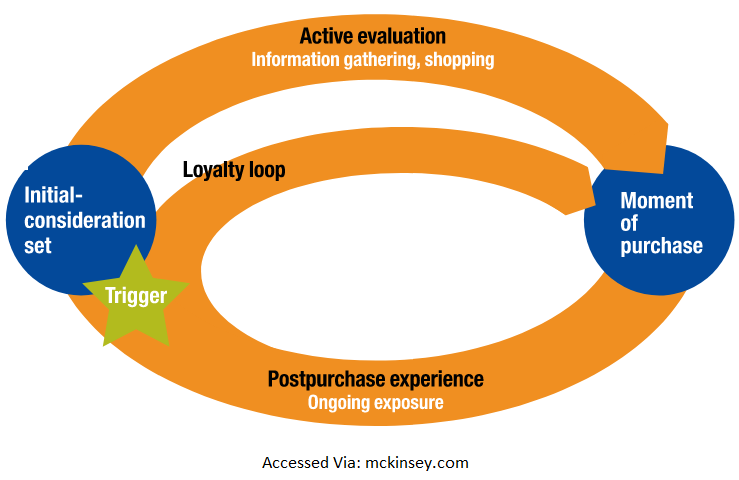
Scenario: Gary has been with his current insurance provider for over 10 years now. He finds them cheap and easy to deal with. Two months before his car insurance is due to renew, Gary receives his renewal letter in the post and is shocked to find out that his premiums are increasing by £150. Using the McKinsey Consumer Decision Journey, we can identify this stage of the customer journey as the Trigger, which can also be known as a customer pain point. Knowing customer triggers helps us as Marketers and Business Owners develop the right marketing messages that will resonate with potential customers.
Initial Consideration: This is when customers will start to consider a group of brands that they think can help solve their problem. They will start to consider which brands to shortlist based on those they have recently been exposed to and their perception about the brands.
How this looks in our scenario: Gary decides to visit a comparison site, as well as some local insurance providers that he has heard about on the radio as well. He makes a shortlist of 3 providers:
- Provider 1 is the cheapest, but he is worried as he has never heard of them and wonders how reputable they are. However, he knows that there are loads of insurance providers out there who he hasn’t heard off and do a good job, so he decides not to discount this one straight away.
- Provider 2 is a well-known insurance provider and £20 more expensive than Provider 1. Gary has seen their advertising on billboards, Facebook and has heard their ad on the radio. He feels more reassured by Provider 2 as they are a larger insurance provider and he has some knowledge of them so feels he can trust them more.
- Provider 3 is priced the same as provider 2, they are a local provider with offices in town and have included some extra benefits. Gary likes that they are local as it means he can visit their office in town and speak to someone face to face if he has any questions instead of ringing a call centre.
However, Gary doesn’t decide then and there. He decides to come back to it because he still has 2 months before his insurance expires and there are other more urgent things he needs to do.
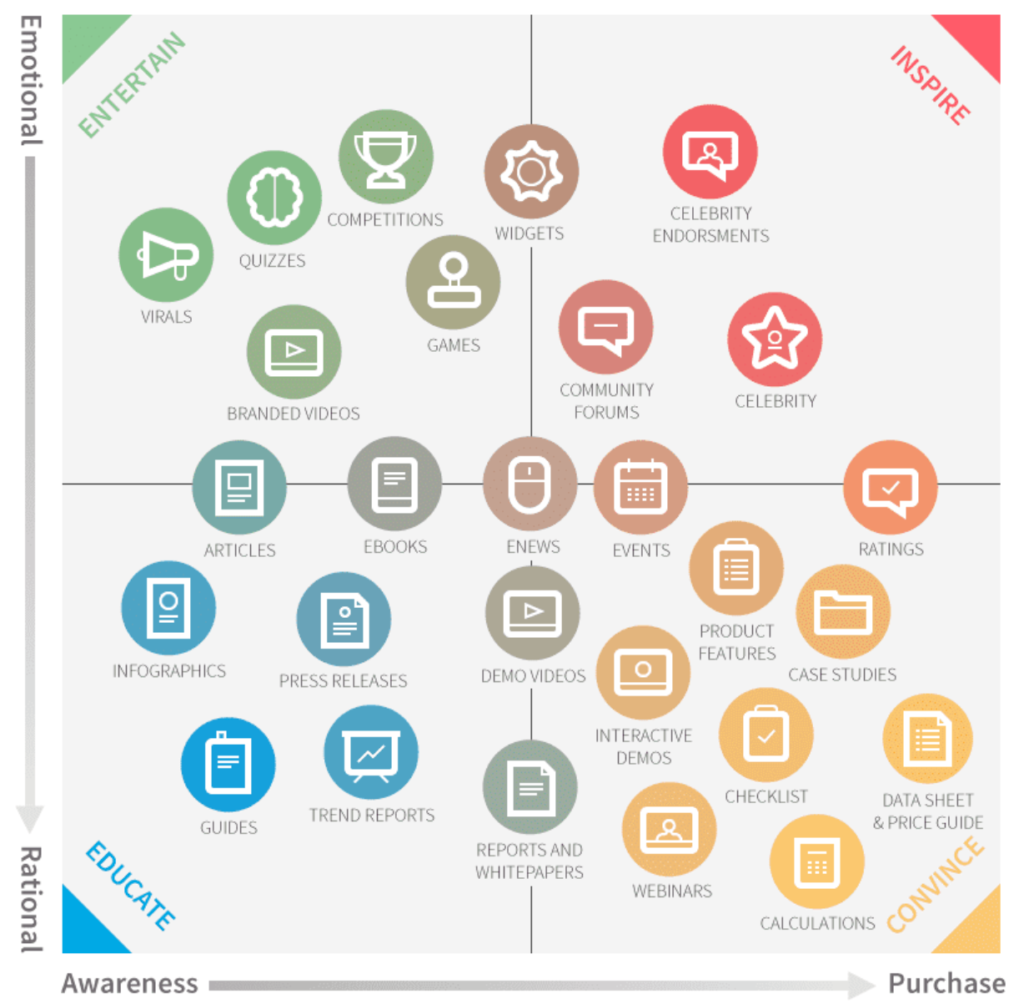
Active Evaluation: This is when customers start to add or subtract brands by evaluating what they want. Think of it as the stage when customer shop around and make comparisons between other brands offering similar products. For business owners it is important to remember not to just advertise the service or product features but also demonstrate qualities such as, trust, helpfulness etc. A good tool to help guide you on the type of content to produce for your prospective customers based on the action you want them to take is the Content Marketing Matrix. Remember, just because a prospective customer has found your website and taken the first step in their journey doesn’t mean that they will complete their journey. You must actively try to get them back, because if you don’t another business will.
Update on our scenario: A few weeks have passed, and Gary still hasn’t decided about his car insurance. He has received reminders from Provider 1 & 2 but nothing from provider 3. In addition to the reminders, Provider 1 has also sent him emails with customer reviews on, tips for keeping your car maintained in the winter and he has also started to notice their ads on Facebook and Instagram. All of this has helped increase Gary’s trust in them, so decides to purchase his car insurance from them.
Moment of Purchase: This stage is relatively straight forward to explain, it is the stage when a customer makes a purchase. At this stage of the journey business owner’s need to think about how easy it for is customers to purchase from them. In Gary’s case all he has to do is visit the website and enter in a few details. He likes that before he starts the process, there is a clear list of all the things he will need to complete the process. There is also a chat facility to help him if he gets stuck. By developing these tools, Provider 1 has ensured that Gary’s is able to purchase his insurance without any hassle and in a timely manner.
Post Purchase Experience: This is described as the stage where the ‘consumer builds expectations based on experience to inform the next decision’. That next decision is called the ‘Loyalty loop’ when a customer will decide on whether to become a repeat customer. Back to our scenario: A few hours after completing his purchase with the insurance provider Gary receives an email telling him that his new insurance is now live and that if he wishes to make any changes to his policy or print off his policy document, he can login to his own customer portal. He also receives an email asking him for his feedback and if they can do anything to improve their service.
Throughout the next 12 months Gary receives regular newsletters from his insurance company with some useful information about car maintenance and extra services he might find useful. When he receives his renewal letter his notices that his premium has only increased by a few pounds so decides to stay with the provider as they made everything simple, and he is happy with the service.
This blog contribution was written by Belfast Academy of Marketing Associate Jane Roper, Marketing Specialist at Co-ownership and owner of Behind the Ad Marketing Consultancy – “Taking the ‘Huh?’ Out of Marketing”. Find out more about Jane and all our team here.